
François Ozon's Swimming Pool: The writer as voyeur

François Ozon's 2003 erotic thriller Swimming Pool follows Sarah Morton (Charlotte Rampling) a successful yet dissatisfied crime novelist as she spends some time away from stuffy England at her publishers home in France.

Spoilers ahead…
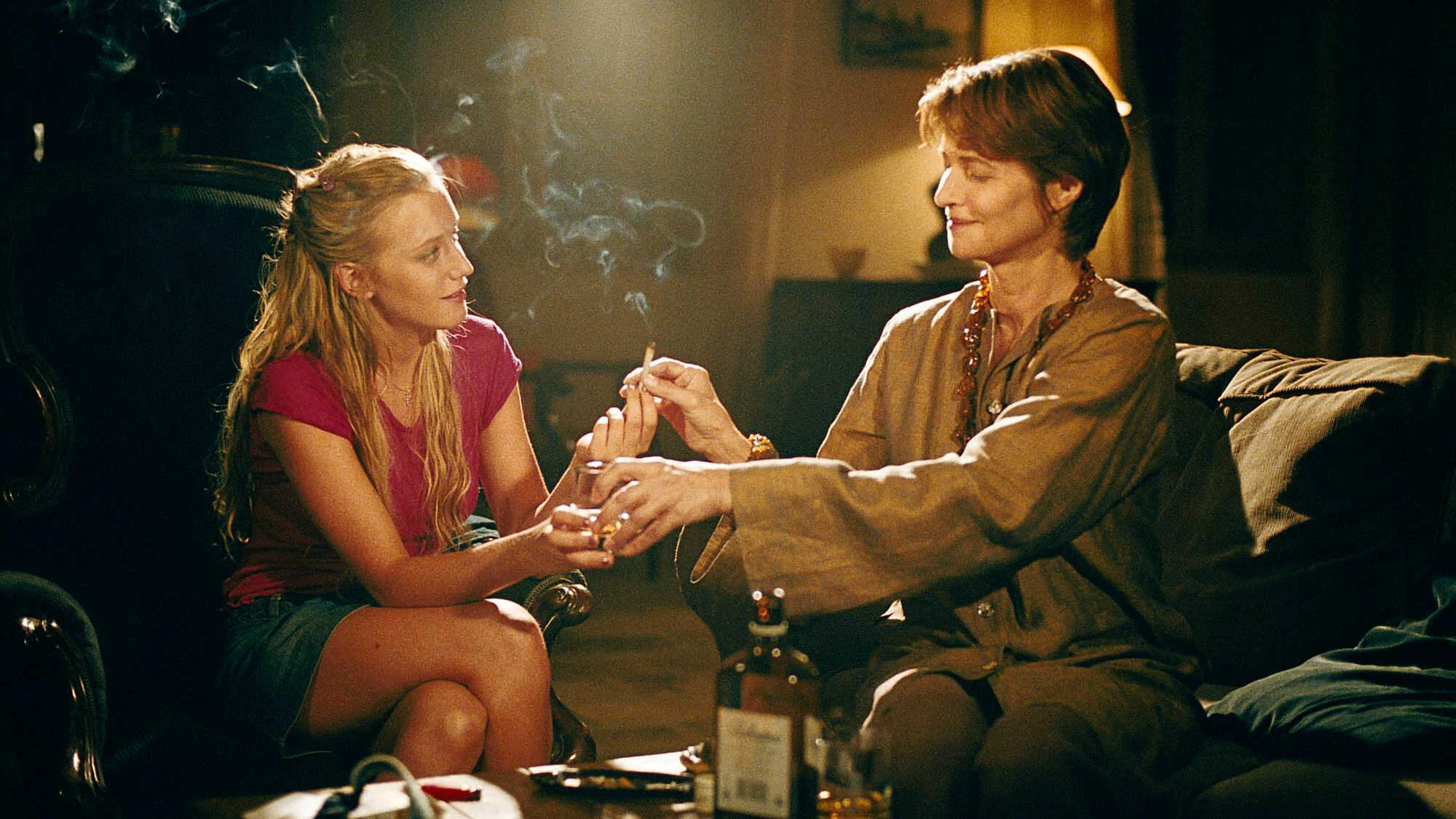
From the get-go Morton is uptight and bizarre, her excessive consumption of yoghurt is rather uncanny, her interaction with a fan on the tube and simmering jealousy of a new writer is telling. She’s going to undergo a metamorphosis and become less stoic and boring by the end of the film. But how she gets there is going to be rather interesting.

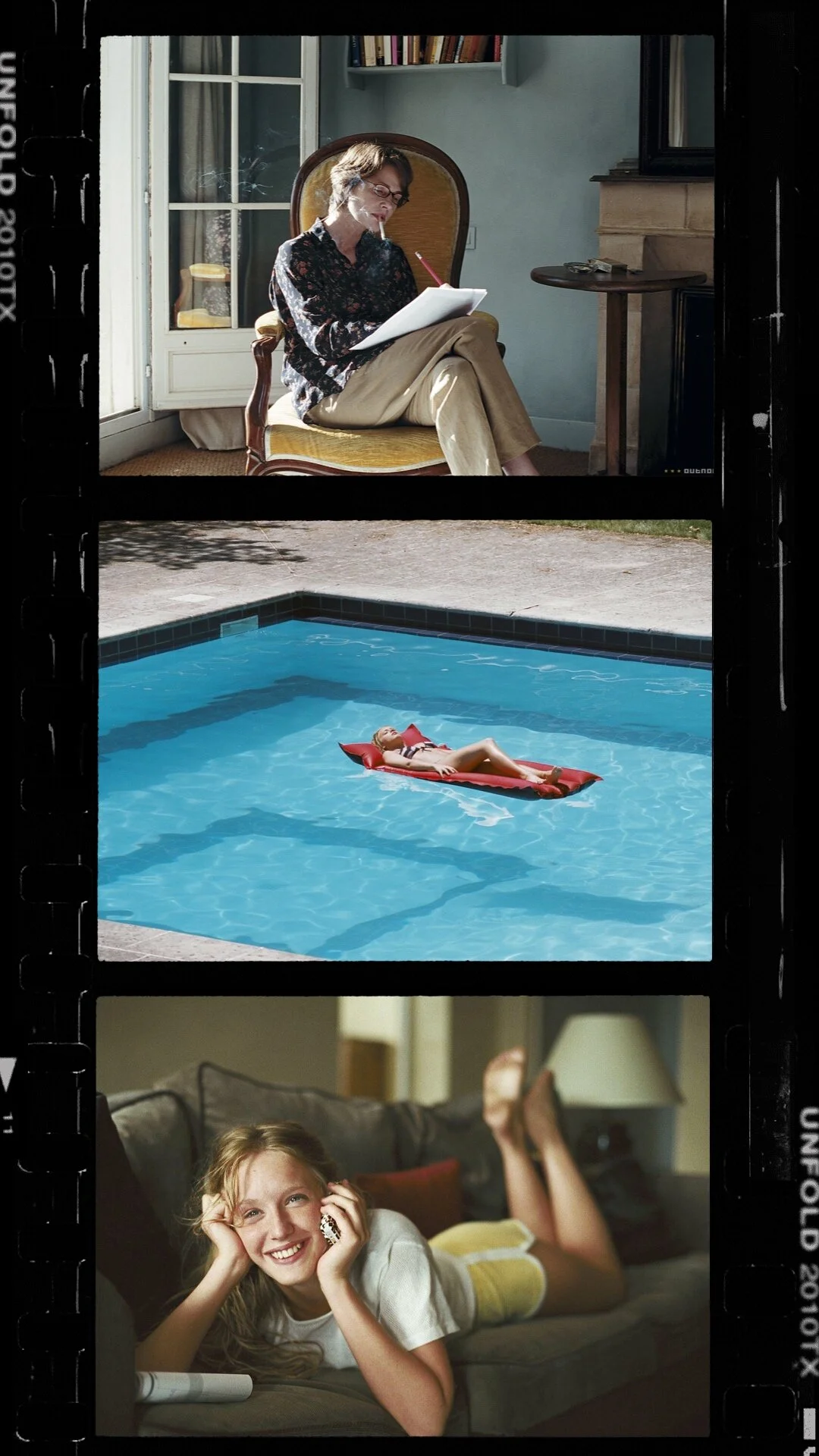
Morton is also a voyeur, she watches Julie (the daughter of the publisher whose house Sarah is staying at) have sex with a random stranger one night and often finds herself watching her when she swims and also becomes irritated by Julie talking and laughing on the phone. A weird obsession grows. There's also a scene in Sarah’s imagination where the camera tracks the contours of Julie’s body as she sunbathes, it’s almost the male gaze at work but it’s actually Sarah’s gaze, her authorial imagination at work.

I feel like the writer as a voyeur is such an obvious yet intriguing trope in thrillers. I mean writers definitely have to be voyeurs to some extent, people-watching is a socially acceptable form of voyeurism. But a thriller always makes them a little more creepy, and to be honest, Rampling makes this trope work so well that it almost feels fresh again.

“When someone keeps an entire part of their life secret from you, it's fascinating and frightening”

However, this is when things start to get complicated, Julie reads Sarah’s book and invites the local waiter Frank (to who Morton has taken a liking) over to make her jealous, they party. The morning after a panicked Sarah sees the pool covered up with a lump in the middle of the tarpaulin. Is Frank dead? No, it’s just the inflatable lilo. This moment was done well, it was predictable but it still makes your skin crawl for the duration of the scene.

Unsurprisingly, Frank does actually turn up dead, the two women bury him and vow to get on with their lives, Sarah even has to seduce the gardener after he starts to inspect the grave they dug the night before.

But this is all a ruse.

The entire plot of the film is put into question when an emboldened Morton returns to London with her finished novel and announces to her publisher that she has signed with someone else to release the book. Upon leaving the office a young girl enters and is addressed as Julie and greets her father. The Julie in France is not the real Julie in fact she never existed at all!

What a brilliant twist. She’s just an over-imaginative and slightly perverse writer. The metamorphosis I mentioned earlier happens because she gets her inspiration back, she blooms again because she has written something that excites her. I love how Ozon weaved this narrative and for a while, I thought it was going to follow an obvious course but I was really pleasantly surprised.

Ozon himself said ‘Charlotte's character kept mixing fantasy and reality. Although in Swimming Pool, everything related to fantasy is part of the act of creation, so it is more channelled and less likely to end up causing madness. In terms of directing, I've treated everything that is imaginary in Swimming Pool in a realistic way so that you see it all – fantasy and reality alike – on the same plane.”
page0 9.JPG

So I think I have Aphantasia...

In recent years I’ve come to realise that I’m not quite normal.

Try this; imagine a horse. Can you see it in your mind? I can’t.

So, I know what a generic horse might look like, but I can’t actually see anything when I close my eyes and will myself to imagine it. For years I thought this was just normal and that people who could see things in their minds like my older sister were unique. It’s the kind of thing people don’t really talk about that much actually.

It turns out it’s the other way around, and there’s a name for what the weirdos (just kidding) like me have. It’s Aphantasia, and according to the Aphantasia Network, around 2% of the population have it! 😱

So what is Aphantasia exactly?

Everyone imagines differently, and some people have weaker images in their minds than others but, Imagination Blindness (the other name for Aphantasia) is the complete absence of visual imagery.

Basically, it’s like a turned-off TV screen when I close my eyes, absolute nothingness; I can’t manifest an image no matter how hard I try.

Remember that horse from earlier?

Over-Project (7).png

What do you see? Let me know in the comments.

If you’re a 1, maybe you have Aphantasia too! It’s not a completely accurate test, but it does reveal how others see images in their minds.

I still can’t get over the fact that phrases like ‘mind’s eye’ or ‘I see what you mean’ never made me second guess that I was something of an anomaly. Perhaps I just thought they were random sayings like ‘A different kettle of fish’ and all those other weird English language phrases that don’t make any sense until you read about their origins on Wikipedia.

For an aspiring writer/film director, this kind of sucks, but I still have an imagination; I think I imagine in words and kind of like how AI scans through all the things it’s ever encountered to create something. I’m not sure; it’s all rather mysterious tbh.

Find out more about Aphantasia.

When Art meets Fashion

When I heard that Uniqlo were doing a collaboration with the Louvre, I had a moment. Like I am obsessed with Art, especially the whole renaissance and baroque era, I just love it.

Somewhere in Italy in 2013. It’s hot and I’m looking up at the creation of man in a room packed to the brim, over an audio system a man says “Silenzio” intermittently in a monotone voice. I feel a rush of awe as I stare at one of the greatest artistic achievements in the history of man.

But is appreciating Nessus Abducting Deianeira problematic in itself, a painting in the male gaze depicting and romanticising male on female violence. Am I perpetuating the patriarchy by buying a T-shirt that portrays a woman in flight fearing for her life? Perhaps. That’s the problem with art, it’s open to interpretation and what once was normal and beautiful may no longer be.

But I can’t help but feel drawn to these paintings, I adore the craftmanship and the ethereal quality to them. And I must say the well-placed peach and roses in the T-shirt design give Deianeira back a bit of privacy and the omission of the centaur has to mean something. Am I looking into this a bit too much, maybe but when did I not overthink everything? It’s just a part of me, the constant questioning and analysis of thing can quite easily transfer the simple purchase of a T-shirt into a debate on morality….

Luckily in the myth that the painting is based on Heracles saves Deianeira from Nessus the centaur before he can have his way with her. What would a damsel do without her hero, aye? Fun fact for all the Disney Hercules fans out there, Nessus is the centaur that Hercules rescues Megara (aka the best Disney character ever!) from.

Either way, whatever the side of the argument that’s not really an argument your on, you can get the Uniqlo X Louvre T-Shirt here.

Book Club: Freshwater by Akwaeke Emezi

This month we are travelling to Nigeria via Freshwater by Akwaeke Emezi. Emezi is an Igbo and Tamil writer who goes by the pronouns they/them/theirs.

Freshwater is a somewhat autobiographical coming-of-age story and explores the idea of a fragmented self through the story of Ada, a young Nigerian woman who is inhabited by several Ogbanje.

“An ogbanje is an Igbo spirit that’s born into a human body, a kind of malevolent trickster, whose goal is to torment the human mother by dying unexpectedly only to return in the next child and do it all over again.” - Akwaeke Emezi [1]

I was drawn to this story because I remember coming across an Ogbanje in Chinua Achebe’s acclaimed Things Fall Apart and being rather fascinated with the supernatural entity. Here I feel like Emezi is going to use the Ogbanje as a device to explore cultural and individual identity and gender dysphoria, which are such compelling and important subject matters. Especially, as we are still living in a time where transphobia rife.

IMG_1230.jpg

It’s undeniable that literature is a powerful tool in the road to normalisation and through reading, I have become a more understanding and accepting person, and for that reason that I why I have selected Freshwater as our March book.

Where to purchase your copy of Freshwater

Audio: Audible

Secondhand: Abebooks

New: Bookshop.org 

Just check back here at the end of each month to discuss the book and find out what we’ll be reading the following month.

The Journey So Far…

download.png

[1] Emezi, A., (n.d.) Transition My surgeries were a bridge across realities, a spirit customizing its vessel to reflect its nature.. [online] The Cut. Available at https://www.thecut.com/2018/01/writer-and-artist-akwaeke-emezi-gender-transition-and-ogbanje.html [Accessed 6 March 2021].