In The Mood for Love: A Valentine's Day Lockdown Watchlist

I have created a video with all the best romance movies to watch while in lockdown this Valentine's Day. There’s classic romances, French gems such as the always charming Amelie and one of the most tragic love stories I have ever watched.

Let me know in the comments section what your favourite romance movies are.

January Books

It’s been a slow start to the year in terms of reading, but I have nevertheless enjoyed all of the books I read this month, which doesn’t usually happen!

A Handful of Dates by Tayeb Salih

I read this super short story…like really super short (it’s 5 pages!) by Salih because I fell in love with his writing style last year after reading Seasons of Migration to the North, a powerful post-colonial novel set in Sudan. Again, he manages to evoke a sense of setting and lifestyle quite vividly, even in just 5 pages! Can’t wait to read The Wedding of Zein and any other translations I can get my hands on

The Bell Jar by Sylvia Plath

I listened to The Bell Jar on audible, and I must say Maggie Gyllenhaal’s narration is perfection. I so was immersed in the story, and I really enjoyed her intonation and how she performed this very conversational and confessional text. As for the narrative itself, wow, it was dark…and uncomfortably relatable in some places. I’ve been through some dark times in my life and the toxic thought patterns and destructive behaviour that Esther partakes in felt a bit too close to home! But overall The Bell Jar is a powerful story and is perhaps overshadowed by the tragedy of Plath herself, she, unlike Esther, succeeded in taking her own life. Is succeeded even the right word here?

The Prose Edda by Snorri Sturluson - Book Club Pick

Norse Mythology has interested me for years, and it’s almost ridiculous that I have only just read it now. The main and one of the only surviving collections of Norse myths! Because Vikings, like the Greeks and other “ancient” civilisations, had a largely oral tradition, it is often many years later that the stories are written down. Such was the case with The Prose Edda; the believed author Sturlusson was a Christian and writing perhaps 400 years later! This makes the reading of Edda rather intriguing…or is that just my English Lit brain firing up again…ooh authorial intent…what can I infer from this.

It’s also worth noting that this text has inspired so much from J.R.R Tolkein’s legendary Middle Earth books (fun fact many names like Gandalf and Thorin (from The Hobbit) are taken from The Prose Edda!) to the wonderful American Gods by Neil Gaiman (and its fantastic TV adaptation which is currently airing its 3rd season on Amazon Prime). And, of course, you can’t forget Marvel, which with its hilarious and playful spin on the original mythology, has made Thor, Loki, Odin and Heimdall household names.

I enjoyed dipping in and out of The Prose Edda (which was the first Book Club pick, February’s selection will be announced soon!) while bundled under a blanket with a fire crackling…on my tv screen and sipping coffee. To borrow from the Danes, reading this book has been a wonderful dose of Hygge these past few weeks.

Disclaimer: The above links are affiliate links, so I do make a small commission if you make a purchase through them.


 
The Prose Edda
 

Let me know in the comments section what books and short stories you’ve read this month.

French Cinema: La Haine (Hate) Review

La Haine follows three young men in the banlieues (suburbs) of Paris for almost 24 hours as they navigate the aftermath of a riot wherein a friend has been shot. Directed by Matthew Kassovitz and starring Vincent Cassel, Hubert Koundé and Saïd Taghmaoui, this hard-hitting French film from 1995 still feels just as relevant in 2021. How is that possible?!

Presented in a stark but beautiful monochrome palette, La Haine holds nothing back. The narrative explores a wealth of topics including race, masculinity, police brutality, poverty, the aimlessness of youth and societal expectations. In most cases, this would be too much material to cover coherently in a film; however, the simplicity of the 24h timeline makes it possible.

« C'est l'histoire d'un homme qui tombe d'un immeuble de 50 étages. Le mec, au fur et à mesure de sa chute, il se répète sans cesse pour se rassurer: Jusqu'ici tout va bien. Jusqu'ici tout va bien. Jusqu'ici tout va bien. Mais l'important, c'est pas la chute, c'est l'atterrissage. »

“Heard about the guy who fell off a skyscraper? On his way down past each floor, he kept saying to reassure himself: So far so good... so far so good... so far so good. How you fall doesn't matter. It's how you land!”

The story of the falling man is repeated throughout the film. This is an obvious metaphor for the three central characters and society as a whole (which Cassel’s character notes later on). It’s also interesting that graffiti and billboards have ironic messages throughout the film such as ‘L'avenir c'est nous’ (We are the future) and ‘Le Monde est à vous’ (The world is yours) which Saïd changes to ‘Le Monde est à nous’ (The World is ours). Escaping the poverty of the banlieues is impossible for these young men because society doesn’t allow them the chance to better themselves.

Another motif that drives the plot, perhaps just as much as the falling man story is the gun. Vinz carries the police revolver for most of the film, its always present but hidden from sight. Another metaphor, but for violence this time. It’s also a device that builds tension and is a literal use of the narrative technique Chekov’s Gun. “If you say in the first chapter that there is a rifle hanging on the wall, in the second or third chapter it absolutely must go off. If it’s not going to be fired, it shouldn’t be hanging there.“ (Chekov, 1911). We are anxious throughout the film because we know that this gun will be used, but up until the very last moment of the film, we don’t know how or when!

« Je me sens comme une petite fourmi perdue dans un univers intergalactique »

“I feel like a little ant lost in an intergalactic universe.”

Normally films become less and less relevant as the year’s pass, or they become offensive because of how backwards their representations were (Hello, Mickey Rooney as Mr Yunioshi in Breakfast at Tiffany’s and Laurence Olivier in blackface as Othello!). Unfortunately, La Haine is feeling more and more relevant, especially in the last year with the Black Lives Matter marches around the world.

 
page0 4.JPG
 

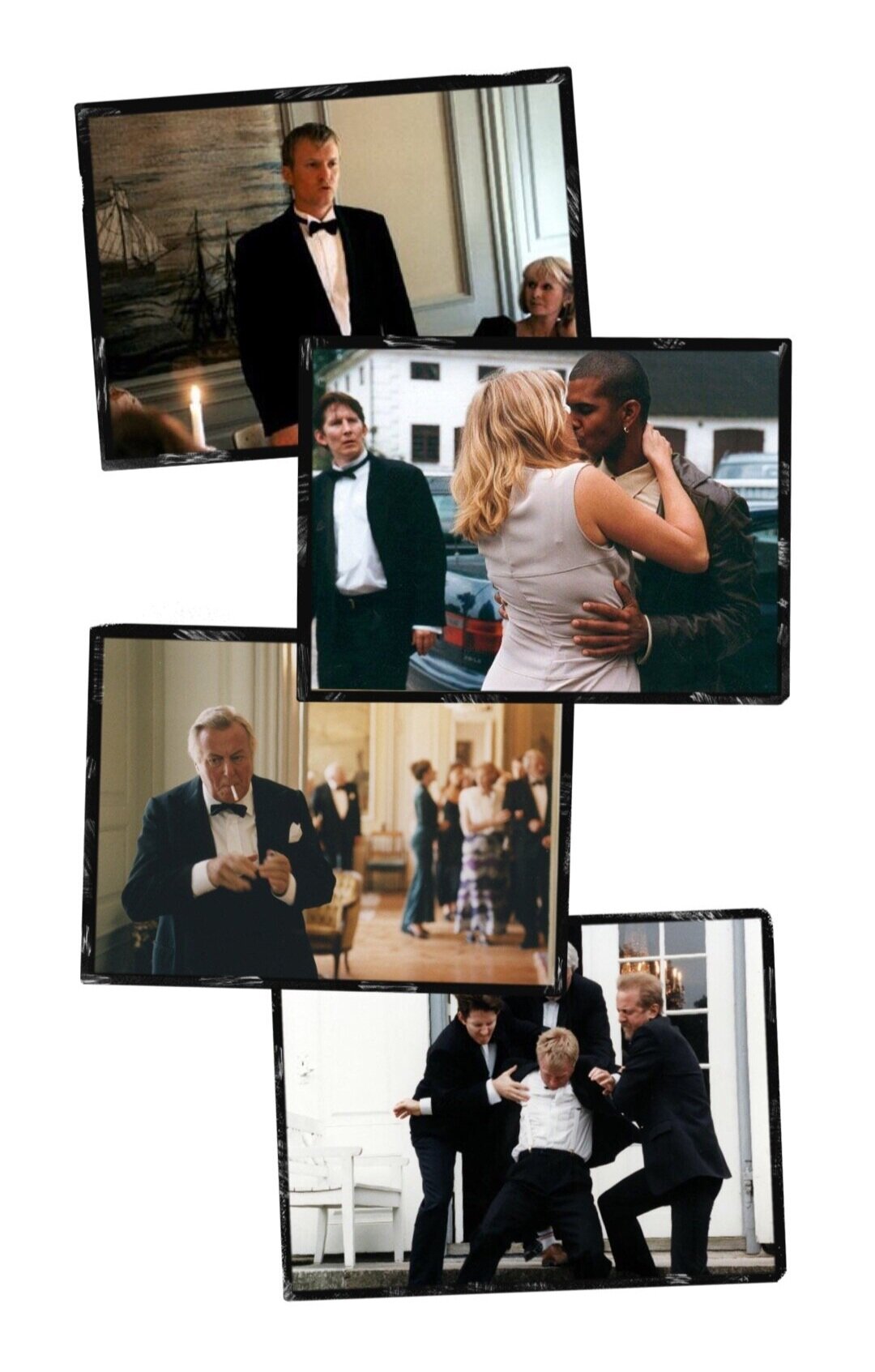
Danish Cinema: Festen (The Celebration or Dogme #1) Review

Festen is Thomas Vinterberg’s first and only film under the Dogme Manifesto. The manifesto of 10 rules that he and Lars Von Trier created was an experiment in filmmaking and a way to create purity within in the process. Dogme was also an anarchist movement against cinematic convention, a game if you will. They set themselves a challenge and found that great films could be made under strict limitations. However, Dogme became fashionable (there’s Dogme furniture in Denmark!) and no longer a rebellion, which is why Festen is Vinterberg’s first and only Dogme film.


Festen follows a family gathering that turns into chaos and darkness after the eldest son, Christian makes a speech that reveals that he was sexually abused as a child by his father. What makes Festen a compelling watch is how information is slowly drip-fed to the audience; it’s as if we are also guests at the party, learning the truth as events unfold. Moreover, the Dogme filming style furthers this feeling of being one of the guests. The lo-fi lighting and home movie quality of the footage allows us to experience the story as if it is real and that it is us behind the camera capturing the party as it spirals out of control.

Indeed, it is high praise if Bergman himself tells you that your film is a masterpiece, and that’s precisely what happened to Vinterberg. Funnily, Vinterberg then confessed that he had ‘stolen’ a scene from Bergman’s Fanny and Alexander, the moment where all the guests dance through the house (Bergman then countered that he has stolen that from Visconti’s The Leopard). Personally, that is one of my favourite moments of Festen as it shows how chaotic family gatherings can be. Also, the fact that everyone is partaking in a family tradition while simultaneously trying to carry on as normal and ignore Christian’s shock confession is just so darkly comedic. In fact, because the father is so successful and influential, most people can’t believe the truth, and it is only later in the film in a powerful scene that everything is settled. Still, you are completely sucked into the film willing Christian to get through to people until that crucial moment. 

It should also not come as a surprise that Festen has become a successful stage play, having been performed in 15 different languages thus far. It’s easy to see why due to the compact cast and limited setting (the whole film was shot at Skjoldenæsholm Castle) and I personally would love to see how it translates onto the stage as films are often based on plays rather than becoming one later (to my knowledge that is).

 
IMG_0244.jpg